







截止目前,引用Bioss产品发表的文献共30725篇,总影响因子148572.52分,发表在Nature, Science, Cell以及Immunity等期刊的文献共76篇,合作单位覆盖了清华、北大、复旦、华盛顿大学、麻省理工学院、东京大学以及纽约大学等国际知名研究机构上百所。 我们每月收集引用Bioss产品发表的文献。若您在当月已发表SCI文章,但未被我公司收集,请致电Bioss,我们将赠予现金鼓励,金额标准请参考“发文章 领奖金”活动页面。 近期收录2024年6月引用Bioss产品发表的文献共336篇(图一,绿色柱),文章影响因子(IF) 总和高达1886.6,其中,10分以上文献39篇(图二)。
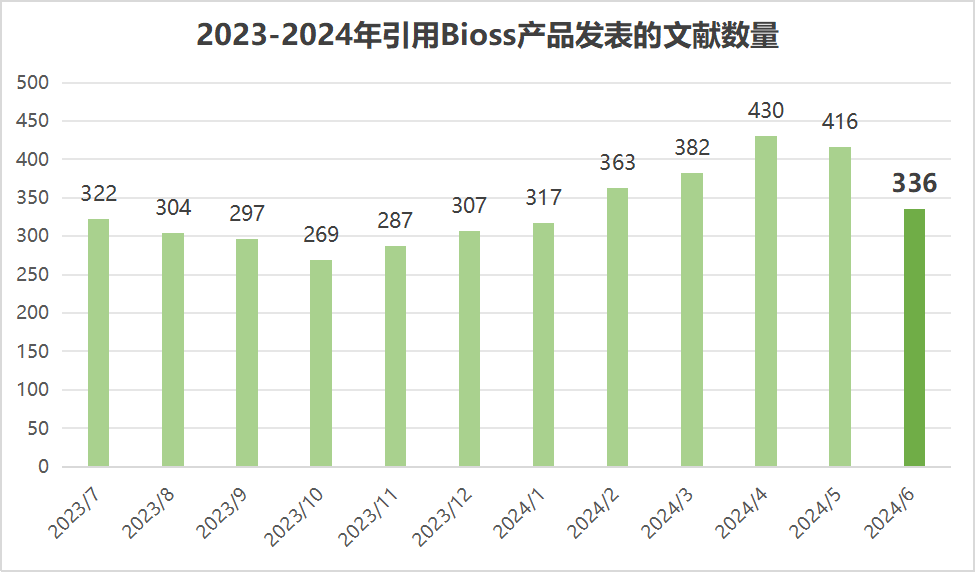
图一
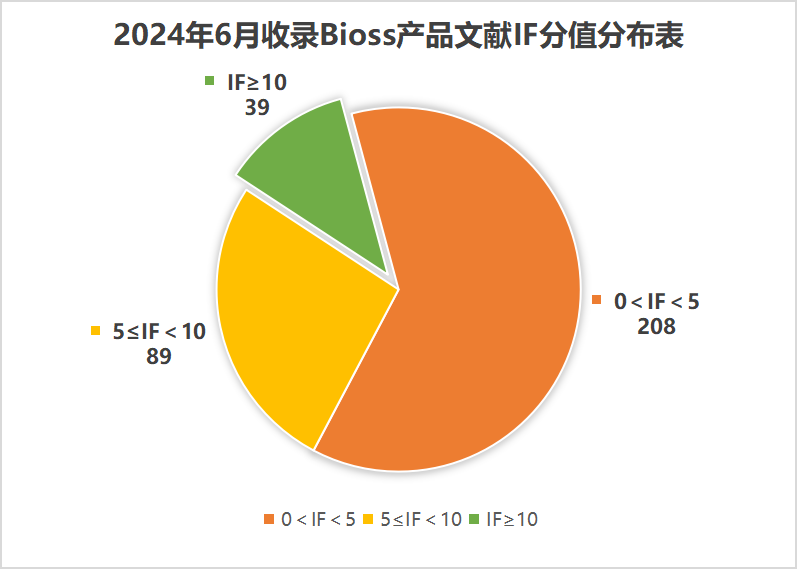
图二
Cell Discovery [IF=33.5]
Nature Microbiology [IF=28.3]
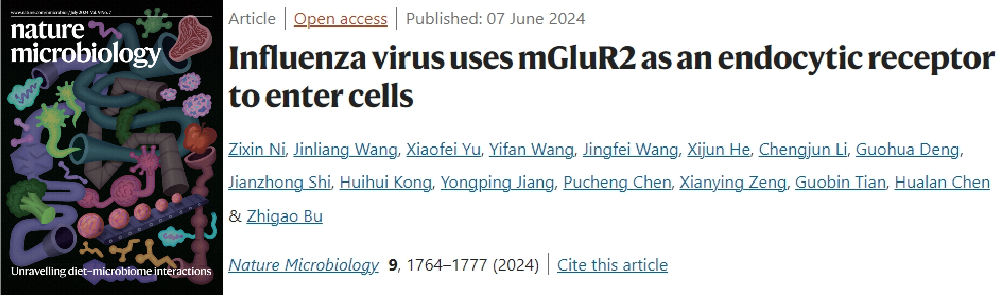
摘要:Influenza virus infection is initiated by the attachment of the viral haemagglutinin (HA) protein to sialic acid receptors on the host cell surface. Most virus particles enter cells through clathrin-mediated endocytosis (CME). However, it is unclear how viral binding signals are transmitted through the plasma membrane triggering CME. Here we found that metabotropic glutamate receptor subtype 2 (mGluR2) and potassium calcium-activated channel subfamily M alpha 1 (KCa1.1) are involved in the initiation and completion of CME of influenza virus using an siRNA screen approach. Influenza virus HA directly interacted with mGluR2 and used it as an endocytic receptor to initiate CME. mGluR2 interacted and activated KCa1.1, leading to polymerization of F-actin, maturation of clathrin-coated pits and completion of the CME of influenza virus. Importantly, mGluR2-knockout mice were significantly more resistant to different influenza subtypes than the wild type. Therefore, blocking HA and mGluR2 interaction could be a promising host-directed antiviral strategy.
Drug Resistance Updates [IF=24.3]
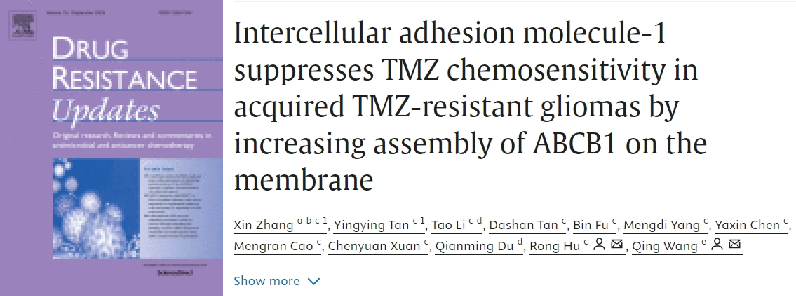
摘要:Acquired TMZ resistant (TMZ-R) glioma models heightened production of intercellular adhesion molecule-1 (ICAM1) in TMZ-R glioma cells. Additionally, we observed a significant suppression of TMZ-R glioma proliferation upon inhibition of ICAM1, which was attributed to the enhanced intracellular accumulation of TMZ. Our findings provide evidence supporting the role of ICAM1, a proinflammatory marker, in promoting the expression of ABCB1 on the cell membrane of TMZ-resistant cells. We have elucidated the mechanistic pathway by which ICAM1 modulates phosphorylated moesin, leading to an increase in ABCB1 expression on the membrane. Furthermore, our research has revealed that the regulation of moesin by ICAM1 was instrumental in facilitating the assembly of ABCB1 exclusively on the lipid raft of the membrane.
Bioactive Materials [IF=18.9]
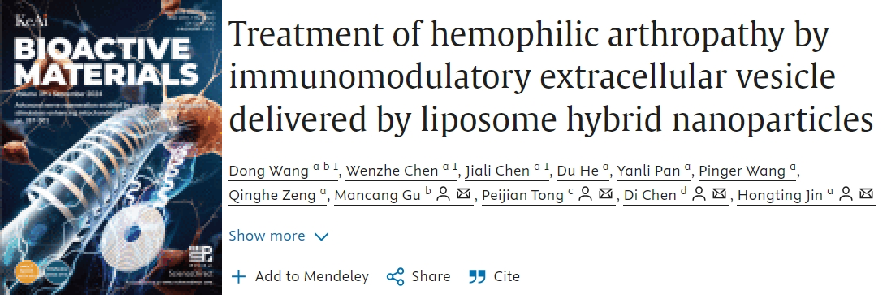
Bioactive Materials [IF=18.9]
摘要:Osteochondral tissue is a highly specialized and complex tissue composed of articular cartilage and subchondral bone that are separated by a calcified cartilage interface. Multilayered or gradient scaffolds, often in conjunction with stem cells and growth factors, have been developed to mimic the respective layers for osteochondral defect repair. In this study, we designed a hyaline cartilage-hypertrophic cartilage bilayer graft (RGD/RGDW) with chondrocytes. Previously, we demonstrated that RGD peptide-modified chondroitin sulfate cryogel (RGD group) is chondro-conductive and capable of hyaline cartilage formation. Here, we incorporated whitlockite (WH), a Mg2+-containing calcium phosphate, into RGD cryogel (RGDW group) to induce chondrocyte hypertrophy and form collagen X-rich hypertrophic cartilage. This is the first study to use WH to produce hypertrophic cartilage. Chondrocytes-laden RGDW cryogel exhibited significantly upregulated expression of hypertrophy markers in vitro and formed ectopic hypertrophic cartilage in vivo, which mineralized into calcified cartilage in bone microenvironment. Subsequently, RGD cryogel and RGDW cryogel were combined into bilayer (RGD/RGDW group) and implanted into rabbit osteochondral defect, where RGD layer supports hyaline cartilage regeneration and bioceramic-containing RGDW layer promotes calcified cartilage formation. While the RGD group (monolayer) formed hyaline-like neotissue that extends into the subchondral bone, the RGD/RGDW group (bilayer) regenerated hyaline cartilage tissue confined to its respective layer and promoted osseointegration for integrative defect repair.
Bioactive Materials [IF=18.9]
摘要:Bioactive glasses (BG) play a vital role in angiogenesis and osteogenesis through releasing functional ions. However, the rapid ion release in the early stage will cause excessive accumulation of metal ions, which in turn leads to obvious cytotoxicity, long-term inflammation, and bone repair failure. Inspired by the vibration exciter, small extracellular vesicles (sEVs) obtained by treating mesenchymal stem cells with copper-doped bioactive glass (CuBG-sEVs), is prepared as a nano-vibration exciter. The nano-vibration exciter can convert the ion signals of CuBG into biochemical factor signals through hypoxia-inducible factor 1 (HIF-1) signaling pathway and its activated autophagy, so as to better exert the osteogenic activity of BG. The results showed that CuBG extracts could significantly improve the enrichment of key miRNAs and increase the yield of CuBG-sEVs by activating HIF-1 signaling pathway and its activated autophagy. Cell experiments showed that CuBG-sEVs are favor to cell recruitment, vascularization and osteogenesis as the enrichment of key miRNAs. The animal experiments results showed that CuBG-sEVs stimulated angiogenesis mediated by CD31 and promoted bone regeneration by activating signaling pathways related to osteogenesis. These findings underscored the significant potential of sEVs as alternative strategies to better roles of BG.
ACS Nano [IF=17.1]
摘要:Photothermal modulation of neural activity offers a promising approach for understanding brain circuits and developing therapies for neurological disorders. However, the low neuron selectivity and inefficient light-to-heat conversion of existing photothermal nanomaterials significantly limit their potential for neuromodulation. Here, we report that graphdiyne (GDY) can be developed into an efficient neuron-targeted photothermal transducer for in vivo modulation of neuronal activity through rational surface functionalization. We functionalize GDY with polyethylene glycol (PEG) through noncovalent hydrophobic interactions, followed by antibody conjugation to specifically target the temperature-sensitive transient receptor potential cation channel subfamily V member 1 (TRPV1) on the surface of neural cells. The nanotransducer not only exhibits high photothermal conversion efficiency in the near-infrared region but also shows great TRPV1-targeting capability. This enables photothermal activation of TRPV1, leading to neurotransmitter release in cells and modulation of neural firing in living mice. With its precision and selectivity, the GDY-based transducer provides an innovative avenue for understanding brain function and developing therapeutic strategies for neurodegenerative diseases.
Nano Today [IF=17.1]